
Your First Year as a SOC Analyst in the AI Era: What to Expect
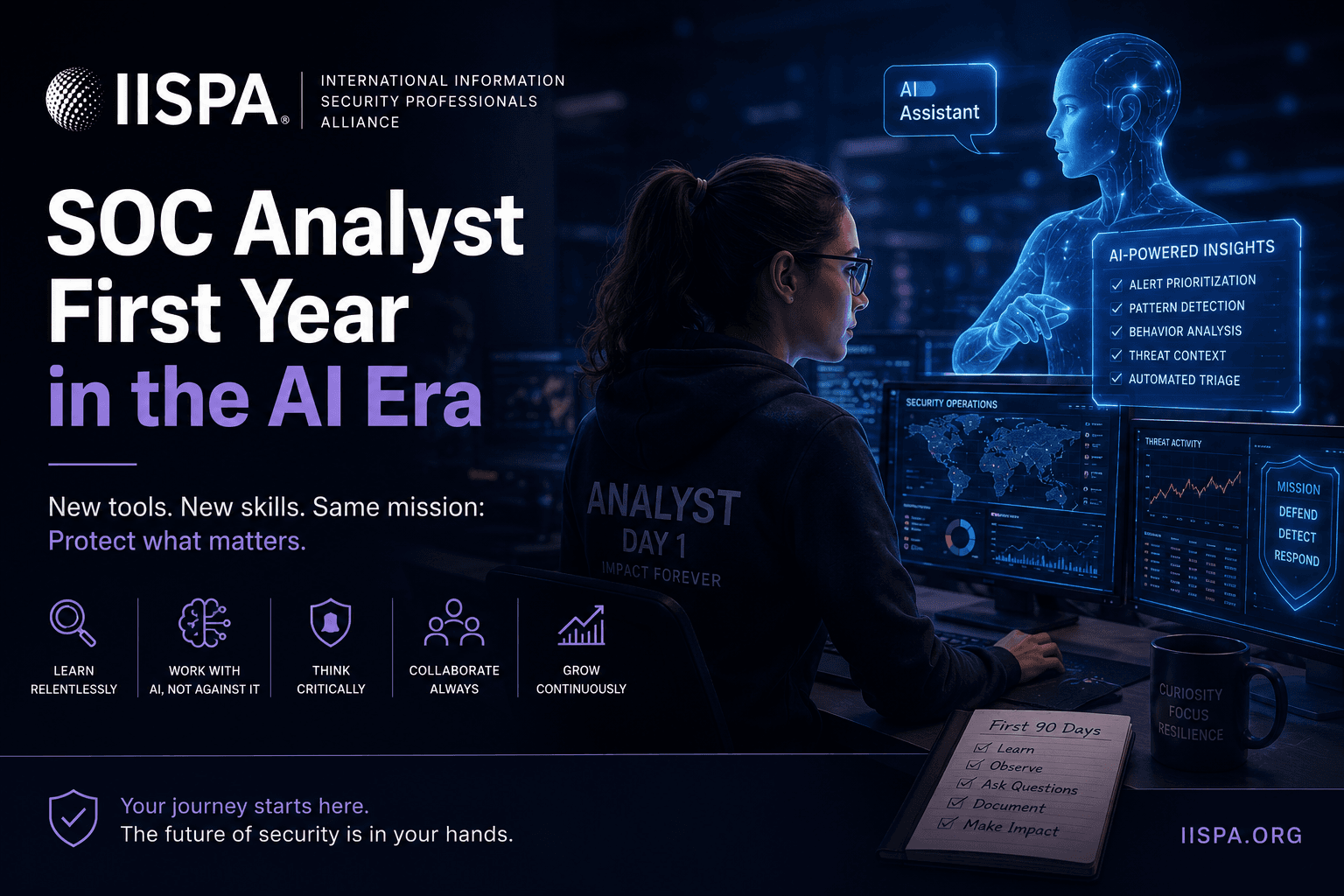
What “SOC” means on week one
A Security Operations Center team exists to detect, investigate, and coordinate response to suspicious activity. Your first role might be titled Analyst I, Junior Analyst, or Security Operations Associate. Regardless of title, your early job is to build judgment under uncertainty.
You will spend time:
- Reading alerts and deciding: true positive, false positive, needs escalation
- Pulling logs from multiple systems and stitching a timeline
- Writing notes the next shift can understand
- Learning the organization’s “normal” so you can spot deviations
Skills that compound (in order of leverage)
1. Structured triage
Use a repeatable mental model:
- What happened? (observable facts)
- What is the scope? (users, hosts, apps, data)
- What is the risk? (impact × likelihood, rough is fine early on)
- What is the next action? (contain, escalate, monitor, close)
2. Log and identity literacy
Most investigations return to who did what, from where, with which account. DNS, DHCP, firewall, proxy, EDR, identity provider logs—learn your environment’s “spine.”
3. Clear writing
Your incidents are read by people under stress. Short sentences, explicit timestamps, and labeled uncertainty (“unknown, need X log”) are professional skills.
4. Basic scripting later, not day zero
Python or PowerShell helps automate repetitive pulls. It becomes useful after you understand what you are automating.
Where AI tools help (and where they hurt)
Helpful when:
- You need a starting hypothesis or a plain-language summary of a dense log snippet
- You want query ideas for SIEM searches (always validate)
- You are learning a new acronym-heavy document and need a study outline
Risky when:
- You accept model output as evidence without source logs
- You paste customer data or credentials into unmanaged tools
- You let summaries replace your own timeline reconstruction
Rule of thumb: AI can be a tutor and a drafting assistant; it cannot be the investigator of record.
A realistic first-year milestone map
| Quarter | Focus | Success signal |
|---|---|---|
| Q1 | Alert hygiene + documentation | Clean handoffs, fewer repeated questions |
| Q2 | Deeper identity investigations | You can explain session anomalies credibly |
| Q3 | One specialty curiosity | Phishing, cloud, or detection logic—pick one |
| Q4 | Teach-back | You mentor an intern or lead a short knowledge share |
Burnout prevention is a skill
Shift work and alert fatigue are real. Sustainable analysts:
- Batch learning instead of constant context switching
- Ask for feedback early (weekly at first)
- Track wins—closed true positives matter
For campus recruiters and hiring managers
Early professionals succeed when onboarding explains why a control exists, not only what to click. Pair AI-era hires with explicit guardrails for acceptable tool use and data handling.
Related certification & CPE resources
ICSP aligns strongly with practitioner depth in security execution and operations. ICCSA supports analysts moving toward governance and assurance conversations. ICCSP becomes relevant as you grow into program leadership. Explore the Certification Path on iispa.org and plan credentials alongside hands-on experience.
Training and CPE through IISPA member resources help you stay current after you land your first role—especially as AI changes log sources and attacker behavior.
More articles like this: IISPA Insights.
IISPA Insights — for cybersecurity professionals building skills that match emerging technology and regulation.